Showing posts with label china. Show all posts
Showing posts with label china. Show all posts
Monday, February 23, 2009
African Agony
Africa has long been plagued by poverty, war, disease and famine. While perhaps not up to that high standard of pox, counterfeiting has also tormented the continent, causing economic loss and hardship for many. Counterfeiting persists even though the margins for counterfeit goods in Africa are quite a bit lower than in the West. This post by the blog Africans in China details counterfeiting problems endemic in Africa, including for such products as Kiwi Shoe Polish and Nice Tooth Brushes.


Tuesday, October 21, 2008
Smoking Dragon, Royal Charm, and the PRO-IP Act
What do you get when you combine four FBI Agents, 62 Chinese smugglers, and a billion counterfeit cigarettes? Besides the plot of a Hollywood potboiler, you get the tale of an intricate counterfeit cigarette bust that spanned several continents, a slew of agents, six years, 1,000 meetings, and enough fake smokes to supply every American man, woman and child with more than a few carcinogenic puffs.
Writing for the Center for Public Integrity, Te-Ping Chen brings her readers into the murky world of counterfeit cigarettes. Through bribery and sheer volume, Chinese cigarette counterfeiters overwhelm the inspection infrastructure in China and the United States. The numbers are startling. A shipping container of one million counterfeit cigarettes can cost about $120,000 to make, but can sell for as much as $2 million in the United States. A bribe of $20,000 can ensure safe passage out of China, and then it becomes a game of chance stacked in favor of the counterfeiter. Cargo containers are only inspected 22% of the time on average in the United States. While seizures are considered a cost of doing business for these smugglers, a run of bad luck seizures tempted the counterfeiters in the story to attempt to purchase protection from the Italian Mafia. Unfortunately for the villains, the Mafia fixers turned out to be FBI agents.
Te-Ping Chen does an excellent job of detailing the intricate nature of the smuggling world. Through the well-worn trade paths of cigarettes also comes counterfeit money, fake pharmaceuticals, and weapons. Notorious bad actors like the North Korean government profit greatly from the criminality. No doubt, a weapon of mass destruction could conceivably slip through safeguards using these same trade routes.
And what does this have to do with PRO-IP Act? Plenty, in fact. The PRO-IP Act goes to the root of the counterfeiting problem by increasing the price of doing business in counterfeits. Doubling the fines per counterfeit violation is a good start. Increasing diplomatic resources will also help, as it could enhance cooperation with law enforcement at the point of origin. And with counterfeit cigarettes often unhealthier than the real thing, criminal penalties for selling counterfeit items that do bodily harm could possibly ensure long jail sentences for the counterfeiters of cigarettes and other types of potentially harmful contraband.
This is an excellent article - entertaining, informative and even poignant in parts. Towards the end of the tale, two of the counterfeiters at the center of the investigation presented their undercover FBI Agent with two Rolexes as a wedding present for the mock gangster. "These aren't counterfeit, are they?" asked the agent. "No," replied the suspect, "these are the real deal."
You'll think Goodfellas, and you won't be far off - or disappointed. Read the whole thing.
Writing for the Center for Public Integrity, Te-Ping Chen brings her readers into the murky world of counterfeit cigarettes. Through bribery and sheer volume, Chinese cigarette counterfeiters overwhelm the inspection infrastructure in China and the United States. The numbers are startling. A shipping container of one million counterfeit cigarettes can cost about $120,000 to make, but can sell for as much as $2 million in the United States. A bribe of $20,000 can ensure safe passage out of China, and then it becomes a game of chance stacked in favor of the counterfeiter. Cargo containers are only inspected 22% of the time on average in the United States. While seizures are considered a cost of doing business for these smugglers, a run of bad luck seizures tempted the counterfeiters in the story to attempt to purchase protection from the Italian Mafia. Unfortunately for the villains, the Mafia fixers turned out to be FBI agents.
Te-Ping Chen does an excellent job of detailing the intricate nature of the smuggling world. Through the well-worn trade paths of cigarettes also comes counterfeit money, fake pharmaceuticals, and weapons. Notorious bad actors like the North Korean government profit greatly from the criminality. No doubt, a weapon of mass destruction could conceivably slip through safeguards using these same trade routes.
And what does this have to do with PRO-IP Act? Plenty, in fact. The PRO-IP Act goes to the root of the counterfeiting problem by increasing the price of doing business in counterfeits. Doubling the fines per counterfeit violation is a good start. Increasing diplomatic resources will also help, as it could enhance cooperation with law enforcement at the point of origin. And with counterfeit cigarettes often unhealthier than the real thing, criminal penalties for selling counterfeit items that do bodily harm could possibly ensure long jail sentences for the counterfeiters of cigarettes and other types of potentially harmful contraband.
This is an excellent article - entertaining, informative and even poignant in parts. Towards the end of the tale, two of the counterfeiters at the center of the investigation presented their undercover FBI Agent with two Rolexes as a wedding present for the mock gangster. "These aren't counterfeit, are they?" asked the agent. "No," replied the suspect, "these are the real deal."
You'll think Goodfellas, and you won't be far off - or disappointed. Read the whole thing.
Wednesday, October 1, 2008
Milking Profits from Fakes
Tainted milk from China has sickened more than 53,000 children while killing 12. While a food safety issue for sure, the recent tainted milk scare is likewise a counterfeit issue. These evil counterfeiters dilute the milk and add industrial chemical melamine to cover their tracks. Milk tainted with melamine masks dilution by tricking protein detectors into detecting the right amount of protein in the milk. Unfortunately, ingestion of melamine causes kidney failure in babies. Parents think they are buying "real milk" for their children, but are instead buying counterfeit milk.
As with many other industries, milk is a good where counterfeiters flourish due to the large payoff and small risks of detection and punishment. Bee Wilson explains in this New York Times Op-Ed piece that the milk tampering problem today in China is in some ways an echo of 19th century New York City. Lack of refrigeration and high demand in densely urban New York gave rise to temptations to dilute milk and cover up the tampering with flour - or worse. The deaths from bad milk sparked a movement that ultimately led to government reform and the establishment of oversight agencies. The American food supply chain, while not perfect, is a heck of a lot better today because of the reforms.
Many of the same conditions occur in China today. Chinese regulatory agencies are still nascent, and are often easily bought off. Children are dying. Popular rage is simmering. But perhaps like 19th century New York, the recent scandals could spark reforms necessary to safeguard the food supply chain from counterfeiters.
Excellent and fascinating piece. Read the whole thing.
As with many other industries, milk is a good where counterfeiters flourish due to the large payoff and small risks of detection and punishment. Bee Wilson explains in this New York Times Op-Ed piece that the milk tampering problem today in China is in some ways an echo of 19th century New York City. Lack of refrigeration and high demand in densely urban New York gave rise to temptations to dilute milk and cover up the tampering with flour - or worse. The deaths from bad milk sparked a movement that ultimately led to government reform and the establishment of oversight agencies. The American food supply chain, while not perfect, is a heck of a lot better today because of the reforms.
Many of the same conditions occur in China today. Chinese regulatory agencies are still nascent, and are often easily bought off. Children are dying. Popular rage is simmering. But perhaps like 19th century New York, the recent scandals could spark reforms necessary to safeguard the food supply chain from counterfeiters.
Excellent and fascinating piece. Read the whole thing.
Tuesday, September 16, 2008
The Sun Never Sets on Counterfeiters
The $600 billion per year counterfeiting problem is detailed in this New York Sun piece by Liz Peek from last week. The article summarizes the problem succinctly:
The article then details a two-pronged strategy to deal with counterfeiting. While enforcement at the production level is difficult in China (the epicenter of the counterfeit trade), consumers can be made aware of the counterfeiting link to drug trafficking, child labor and terrorism, while technology can enhance interdiction of counterfeit goods by law enforcement and merchants. Eastman Kodak is specifically noted for its secret innovation that enables law enforcement to distinguish between authentic goods and even "perfect fakes" with a handheld scanner. Noting the $10 billion per year market for such technology, Peek surmises a windfall for those security experts able to stay one step ahead of the bad guys.
"Designer goods are just the tip of the iceberg. Sales of all counterfeit goods are estimated at more than $600 billion annually, up from $5.5 billion in 1982.... sales of counterfeit pharmaceuticals now total some $70 billion a year worldwide. Some 35% of the software installed on computers in 2005 was fake, more than $12 billion in copied auto parts are sold annually, and there have been more than one hundred airline crashes caused by fake (and faulty) parts. This is a serious and huge business, threatening the health and safety of people everywhere."
The article then details a two-pronged strategy to deal with counterfeiting. While enforcement at the production level is difficult in China (the epicenter of the counterfeit trade), consumers can be made aware of the counterfeiting link to drug trafficking, child labor and terrorism, while technology can enhance interdiction of counterfeit goods by law enforcement and merchants. Eastman Kodak is specifically noted for its secret innovation that enables law enforcement to distinguish between authentic goods and even "perfect fakes" with a handheld scanner. Noting the $10 billion per year market for such technology, Peek surmises a windfall for those security experts able to stay one step ahead of the bad guys.
Monday, September 15, 2008
Mmmmmm...... beer.....
Although not the beloved Duff Beer of mythical Springfield, even the über-parochial Homer J. Simpson would object to counterfeiters entering the beer realm in China.
Hat Tip: Sybeeritic
Hat Tip: Sybeeritic
Thursday, August 21, 2008
Video - How to Tell a Real Golf Ball from a Fake
Courtesy of the Boston Globe, a video and accompanying article that neatly encapsulates the problems of fake golf equipment. Globe reporter Jenn Abelson looks at the counterfeiting issue through the prism of Acushnet, the Massachusetts-based manufacturer of Titleist golf balls and equipment. Acushnet spends more than $2 million per year on an enforcement division that expends considerable time and resources in China investigating golf equipment counterfeiters.
The article explores the difficulty in enforcing rights in China, where counterfeiting operations often only temporarily close down. And those are the good outcomes - prosecutors often decline to prosecute, and factories are often tipped off before raids and investigators approach.
In addition, the article mentions the accelerating trend of using online marketplaces to ship counterfeit goods into the United States, bypassing customs and inspections. The risk of obtaining a counterfeit in such a transaction is still either discounted or not perceived yet by the consumer.
To me, the most interesting part of the article was the trend in some Asian markets to sell fakes alongside genuine golf equipment, showing the price differential between the two. If brands are the hallmark of quality, why would a consumer pay any value for a fake Titleist rather than a no-name brand?
And check out the video for a quick guide on how to tell a real Titleist V1 golf ball from a fake. Like a great smile, it's in the dimples.
The article explores the difficulty in enforcing rights in China, where counterfeiting operations often only temporarily close down. And those are the good outcomes - prosecutors often decline to prosecute, and factories are often tipped off before raids and investigators approach.
In addition, the article mentions the accelerating trend of using online marketplaces to ship counterfeit goods into the United States, bypassing customs and inspections. The risk of obtaining a counterfeit in such a transaction is still either discounted or not perceived yet by the consumer.
To me, the most interesting part of the article was the trend in some Asian markets to sell fakes alongside genuine golf equipment, showing the price differential between the two. If brands are the hallmark of quality, why would a consumer pay any value for a fake Titleist rather than a no-name brand?
And check out the video for a quick guide on how to tell a real Titleist V1 golf ball from a fake. Like a great smile, it's in the dimples.
Tuesday, August 19, 2008
Diplomats on Drugs
Not what you think, but the august and aptly-named Foreign Policy details some foreign policy implications of counterfeiting (paid registration may be required).
The article details the culprits (China and India are the biggest) and introduces the reader to several law enforcement figures who are simply overwhelmed at the sheer volume of the problem. Some enforcement may also require individual acts of heroism. In Nigeria, Dora Akunyili, a 54-year-old pharmacy professor, took over Nigeria's drug watchdog industry in 2001 and fought hard to reduce the percentage of counterfeit drugs in Nigeria. Akunyili succeeded. The Nigerian drug supply chain from 70% in 2001 to close to 10% today. Her efforts are helping to prevent counterfeit drugs from killing innocent Nigerians, like her own sister who died after taking fake diabetes medicine in 1988. These efforts have also endangered Akunyili, who narrowly escaped assassination, had her office blown up, and now lives with round-the-clock bodyguard protection.
On the demand side, humanitarian groups seeking to provide drugs to treat third world health problems are left with a stark choice. Either these groups purchase expensive medications through legitimate sources, or they go through more shadowy channels to purchase drugs that may be counterfeit and do not work.
And publicizing the counterfeiting of any drug is often a losing proposition for these drug companies: when counterfeiting of particular drugs is publicized, the public demand for the drug drops even through legitimate channels.
The World Health Organization (WHO) has taken a lead in trying to stem the tide of counterfeit drugs in the world pharmaceutical supply chain. They face real opposition - often, the governments they attempt to influence are also directly involved in profiting from the trade of counterfeit drugs. And even a powerful and influential organization like the WHO is not immune to political pressure. Quoting from the article:
The article details the culprits (China and India are the biggest) and introduces the reader to several law enforcement figures who are simply overwhelmed at the sheer volume of the problem. Some enforcement may also require individual acts of heroism. In Nigeria, Dora Akunyili, a 54-year-old pharmacy professor, took over Nigeria's drug watchdog industry in 2001 and fought hard to reduce the percentage of counterfeit drugs in Nigeria. Akunyili succeeded. The Nigerian drug supply chain from 70% in 2001 to close to 10% today. Her efforts are helping to prevent counterfeit drugs from killing innocent Nigerians, like her own sister who died after taking fake diabetes medicine in 1988. These efforts have also endangered Akunyili, who narrowly escaped assassination, had her office blown up, and now lives with round-the-clock bodyguard protection.
On the demand side, humanitarian groups seeking to provide drugs to treat third world health problems are left with a stark choice. Either these groups purchase expensive medications through legitimate sources, or they go through more shadowy channels to purchase drugs that may be counterfeit and do not work.
And publicizing the counterfeiting of any drug is often a losing proposition for these drug companies: when counterfeiting of particular drugs is publicized, the public demand for the drug drops even through legitimate channels.
The World Health Organization (WHO) has taken a lead in trying to stem the tide of counterfeit drugs in the world pharmaceutical supply chain. They face real opposition - often, the governments they attempt to influence are also directly involved in profiting from the trade of counterfeit drugs. And even a powerful and influential organization like the WHO is not immune to political pressure. Quoting from the article:
The WHO has been vocal about combating fakes, but even it hesitates to embarrass member countries who allow fake drugs to enter the market. Unfortunately, many observers believe it may take large-scale casualties for real action to occur. As one British drug-security expert put it to me in April, “Action against al Qaeda really only took off after September 11.”Scary stuff. Read it if you have the chance.
Sunday, August 10, 2008
Gold Medal Counterfeiters
Even with increased law enforcement, knock-off shops flourish at the Beijing Olympics.
UPDATE: Counterfeiting the Nazi Olympics.
UPDATE: Counterfeiting the Nazi Olympics.
Friday, August 8, 2008
Counterfeit Olympics
The Olympics Ceremonies have shined a media spotlight on China, and this Sky News piece illustrates the counterfeiting occurring on the streets of Beijing.
The article illustrates two main points - first, that the Chinese government treats its own intellectual property (the Olympic mascots) with greater care than other countries' intellectual property, levying stiff fines and jail sentences for violators of its own IP while mostly turning a blind eye towards other infringement. And second, that these harsher penalties barely make a dent in the trade of counterfeit goods, with Beijing street vendors openly selling fake Olympic wares.
The irony is that through routine lax intellectual property enforcement, the Chinese government has created an environment where its own intellectual property is routinely violated.
The article illustrates two main points - first, that the Chinese government treats its own intellectual property (the Olympic mascots) with greater care than other countries' intellectual property, levying stiff fines and jail sentences for violators of its own IP while mostly turning a blind eye towards other infringement. And second, that these harsher penalties barely make a dent in the trade of counterfeit goods, with Beijing street vendors openly selling fake Olympic wares.
The irony is that through routine lax intellectual property enforcement, the Chinese government has created an environment where its own intellectual property is routinely violated.
Thursday, August 7, 2008
Ink-Stained Wretches
I speak not of fellow journalists (many of whom have clean hands in this New Media age), but of counterfeiters who have been counterfeiting pens. Haco Industries of Kenya manufactures Bic pens, and has been victimized by Chinese-based counterfeiters. Haco claims that its sales of pens are down 40%, primarily due to counterfeiting activities.
This story illustrates an important point - counterfeiters don't only hurt developed countries, but in particular, hurt developing countries. In fact, they often hurt developing countries more, as they are usually burdened with some combination of weaker laws, corrupt law enforcement, limited resources, less developed supply-chain security infrastructure, and a less-informed population and business class.
Africa has long been a cause célèbre with anti-poverty crusaders. The cradle of civilization has been torn apart by war, poverty and famine, and its people have suffered a great deal. A primary goal of good anti-poverty programs is to create self-suficiency - not merely to "give men fish," but to "teach men to fish." This self-sufficiency would allow Africans to create real wealth that in turn reduces famine and the desperate conditions often necessary to stir conflict. Enterprises such as Haco Industries contribute to Africa's tax base while employing scores of young men who might otherwise be fighting and dying. The counterfeiters here are not merely duping unknowing consumers, but helping to destroy the fragile economic ecosystem that has been developing into Africa's best hope for a prosperous and peaceful future. For these counterfeiters, it is not ink that stains their hands - it is blood.
This story illustrates an important point - counterfeiters don't only hurt developed countries, but in particular, hurt developing countries. In fact, they often hurt developing countries more, as they are usually burdened with some combination of weaker laws, corrupt law enforcement, limited resources, less developed supply-chain security infrastructure, and a less-informed population and business class.
Africa has long been a cause célèbre with anti-poverty crusaders. The cradle of civilization has been torn apart by war, poverty and famine, and its people have suffered a great deal. A primary goal of good anti-poverty programs is to create self-suficiency - not merely to "give men fish," but to "teach men to fish." This self-sufficiency would allow Africans to create real wealth that in turn reduces famine and the desperate conditions often necessary to stir conflict. Enterprises such as Haco Industries contribute to Africa's tax base while employing scores of young men who might otherwise be fighting and dying. The counterfeiters here are not merely duping unknowing consumers, but helping to destroy the fragile economic ecosystem that has been developing into Africa's best hope for a prosperous and peaceful future. For these counterfeiters, it is not ink that stains their hands - it is blood.
Tuesday, August 5, 2008
Chinese Counterfeiting Culture
Writing in the Asia Times, Peter Navarro takes a fascinating look at factors contributing to the pervasive Chinese counterfeiting problem. Using the problem of faulty chargers causing fires and electrical hazard, Navarro catalogues the widespread problem, from chargers to handbags to counterfeit drugs. Ending Chinese counterfeiting would be almost impossible, as he cites estimates that counterfeiting activity accounts for 20% of the total Chinese GDP growth, with significant curtailment likely to cause economic instability or collapse. But the problem is even deeper - it is cultural. The kicker:
These economic and political motives for Chinese piracy are strongly reinforced by a set of cultural norms that flow from an amoral fusion of a 60-year old Maoism and a centuries-old Confucianism. The core problem is that the government of the People's Republic of China was founded in 1949 on the abolition of private property. Thus, there exists several generations of Chinese executives who truly believe that, as former US ambassador James Lilley has noted, "any technology in the world is the property of the masses."Read the whole thing.
When one adds to this Maoist version of property rights a large dose of Confucianism, the counterfeiting and piracy picture comes much more sharply into focus. Since ancient times, Confucianism has revered, rather than reviled, imitation. The result is the perfect economic, political, and cultural laboratory for a counterfeiting and piracy boom.
Tuesday, July 22, 2008
A Tisket, A Tasket, A Counterfeited Casket
The counterfeiters thought that their products were dead ringers for the real thing. But their products ended up bringing a lawsuit to life instead.
News out of Houston took on a macabre tone as the York Group, a Pennsylvania-based manufacturer of caskets, sought a temporary restraining order against the Wuxi Taihu Tractor Co. for sales of imitation caskets. The caskets for sale by the Chinese company mimicked the York caskets in "hardware, design lines and paintjobs." This is not the first time the York Group has tangled with this Chinese company. In 2006, the York Group brought a similar and successful suit against Wuxi Taihu Tractor Co. in which the Chinese company was ordered to stop distributing counterfeit caskets and to start putting a "Made in China" label as required by federal law for items made in China.
The article heavily quotes defendants and competitors of York in the Houston area, who disparage York's claims. Patrick Mancini, a wholesale seller of the Chinese coffins, says that he has received no complaints about the knockoff caskets from customers.
Of course, it would be difficult for many of the customers to complain.
News out of Houston took on a macabre tone as the York Group, a Pennsylvania-based manufacturer of caskets, sought a temporary restraining order against the Wuxi Taihu Tractor Co. for sales of imitation caskets. The caskets for sale by the Chinese company mimicked the York caskets in "hardware, design lines and paintjobs." This is not the first time the York Group has tangled with this Chinese company. In 2006, the York Group brought a similar and successful suit against Wuxi Taihu Tractor Co. in which the Chinese company was ordered to stop distributing counterfeit caskets and to start putting a "Made in China" label as required by federal law for items made in China.
The article heavily quotes defendants and competitors of York in the Houston area, who disparage York's claims. Patrick Mancini, a wholesale seller of the Chinese coffins, says that he has received no complaints about the knockoff caskets from customers.
Of course, it would be difficult for many of the customers to complain.
Wednesday, July 2, 2008
Cleaning Up for the Big Show
From Industry Week, an article about Beijing's efforts to clean up counterfeiting before hosting this year's Summer Olympics. Essentially, the article implies that the Chinese Government's desire not to be embarrassed on the world stage by dodgy counterfeit operations exceeds the power of local muckety-mucks to bribe their way into lax enforcement on the local level. The implication, of course, is that the Chinese government can do more in normal times to stop counterfeiting.
Wednesday, September 5, 2007
Cheap Chocolate Will Cost Your Appetite
Most people would probably agree with me in saying that while premium chocolates are divine, a good cheap candy bar now and then is a life necessity.
Then again, I am willing to sacrifice a few extra bills to keep worms out of my chocolates--the appalling truth South Korean consumers were welcomed by after unwrapping 'Made in China' chocolates this week.
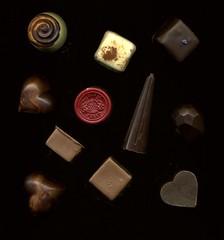
Right now, we're loving Sir Hans Sloane chocolates of London, an exclusive brand that makes premium organic blends of our favorite confection.
Then again, I am willing to sacrifice a few extra bills to keep worms out of my chocolates--the appalling truth South Korean consumers were welcomed by after unwrapping 'Made in China' chocolates this week.
Right now, we're loving Sir Hans Sloane chocolates of London, an exclusive brand that makes premium organic blends of our favorite confection.
Subscribe to:
Posts (Atom)


 Posts
Posts

